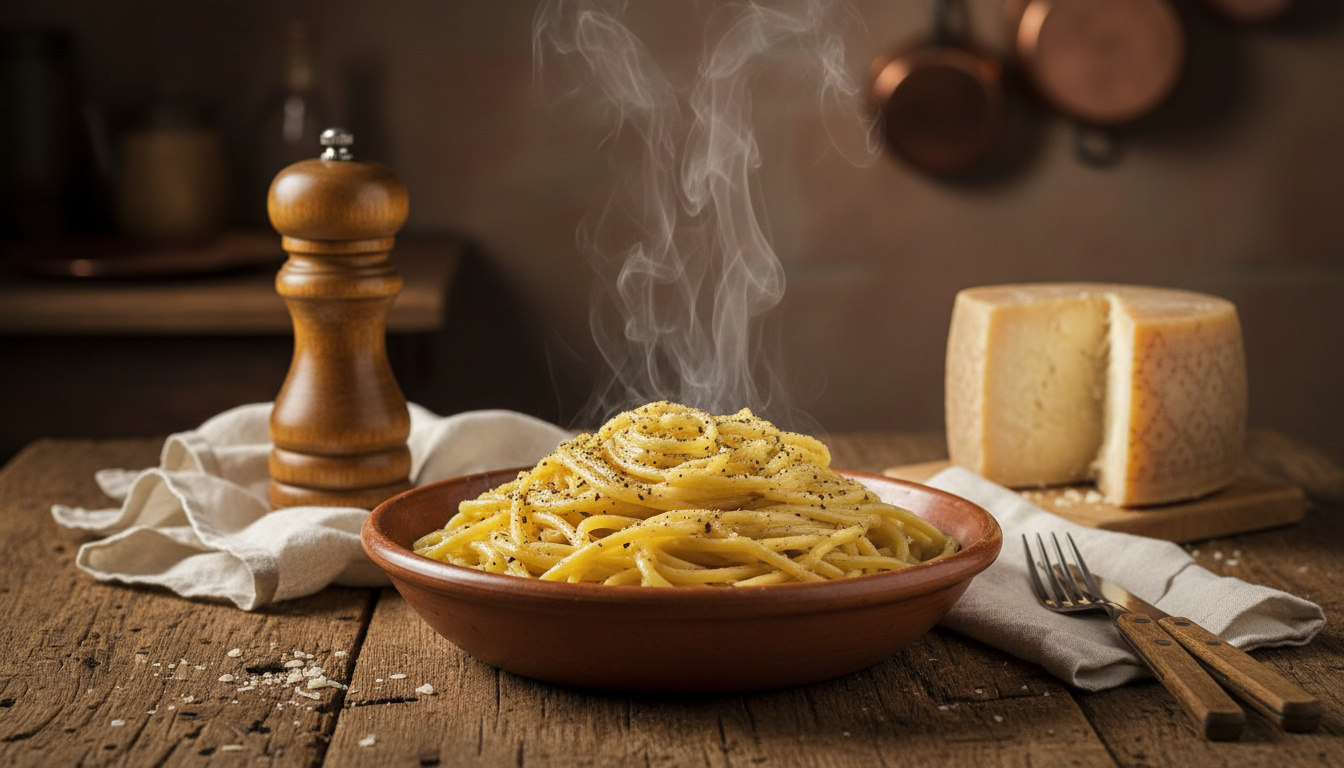
Cacio e pepe represents one of Rome’s essential pasta traditions, built upon just three core ingredients—pecorino romano cheese, freshly ground black pepper, and pasta—transformed by starchy pasta water into a silky, emulsified sauce without cream or butter. The dish demands precise technique rather than complex preparation, challenging cooks to balance heat and hydration to achieve its characteristic creamy texture.
Deceptively simple on paper, this Roman staple separates novice attempts from mastered executions through the chemistry of emulsification. Success relies entirely on the interaction between sheep’s milk cheese proteins and the starch molecules suspended in pasta cooking water, a relationship that breaks easily under excessive heat or improper handling.
To replicate the version served in neighborhood Roman trattorias—including establishments once favored by figures like Anthony Bourdain—requires precise techniques and an understanding of ingredient chemistry.
What Is Cacio e Pepe?
The name translates literally to “cheese and pepper,” reflecting the dish’s minimalist philosophy. Historically, it served as portable sustenance for shepherds who carried aged pecorino and dried peppercorns through the countryside, combining them with fresh-cooked pasta when possible.
- Ingredient Purity: Authentic versions contain absolutely no cream, butter, or olive oil—relying solely on cheese and water chemistry for texture.
- Pasta Selection: Tonnarelli provides superior sauce adhesion due to its square cross-section, though spaghetti and bucatini serve as acceptable alternatives.
- Starch Activation: Starchy pasta water functions as the binding agent, creating natural creaminess through emulsification rather than dairy fat.
- Pepper Preparation: Freshly cracked coarse black pepper delivers essential heat and aromatic oils that pre-ground pepper lacks.
- Risottare Method: Finishing pasta in the pan with pepper-infused water releases additional surface starch critical for sauce stability.
- Thermal Management: Temperature control during final mixing prevents protein clumping and separation.
- Shepherd Origins: The dish emerged from practicality—non-perishable cheese and spice combined with freshly boiled grain.
| Fact | Detail |
|---|---|
| Origin | Rome, Lazio region |
| Translation | “Cheese and pepper” |
| Ingredient Count | 3 base + pasta water |
| Traditional Pasta | Tonnarelli (square spaghetti) |
| Cheese Specification | 100% Pecorino Romano (sheep’s milk) |
| Primary Technique | Starch emulsification |
| Servings | 4 adults |
| Caloric Range | 500-600 per serving |
| Dietary Classification | Vegetarian |
| Related Dishes | Carbonara, Amatriciana, Gricia |
Key Ingredients for Authentic Cacio e Pepe
Standard recipes serving four require 350-400g pasta, 200-250g Pecorino Romano, 1.5-3 teaspoons black pepper, and approximately one cup of reserved pasta water. The quality and handling of these components matters more than their quantity.
What Pasta Works Best?
Tonnarelli remains the preferred choice—its square cross-section and rough surface provide maximal sauce adhesion. Bucatini and spaghetti function as standard alternatives, while sturdy long shapes like linguine or fettuccine can substitute in a pinch. The critical factor involves surface area and texture capable of holding the emulsified sauce rather than letting it slide back into the plate.
Selecting and Preparing the Cheese
Pecorino Romano—sharp, salty sheep’s milk cheese aged for at least eight months—provides the essential flavor profile and melting properties. Pre-grated cheese risks anti-caking agents that prevent proper emulsification. Grating on the finest holes of a microplane or box grater immediately before cooking ensures optimal texture.
Grate Pecorino immediately before cooking using the finest setting available. Pre-grated cheese often contains cellulose that inhibits the emulsification process, resulting in gritty, clumpy sauces rather than smooth coatings.
The Critical Role of Pasta Water
Starchy pasta water acts as the “fourth ingredient,” providing the suspension medium that binds cheese and pepper into a cohesive sauce. The water should appear cloudy and white with dissolved starch. Shallow boiling—using less water than standard package directions—concentrates this starch, while lightly salting the water accounts for the cheese’s inherent saltiness.
Step-by-Step Cacio e Pepe Recipe
The authentic Roman technique centers on risottare—finishing pasta in the pan with pepper water—and creating a stable cheese paste before final emulsification. Following these specific steps prevents the separation and clumping that plague inexperienced attempts.
Preparation and Toasting
Grate the Pecorino finely and set aside. In a large skillet over medium-high heat, toast the freshly ground black pepper for 1-2 minutes until fragrant. This blooming process releases essential oils and enhances the spice’s complexity.
Never add cheese to boiling or excessively hot pasta water. High temperatures cause dairy proteins to seize and separate, creating a greasy, broken sauce rather than the desired creamy emulsion. Remove the pan from heat before incorporating cheese.
The Boil and Reserve
Bring a shallow pot of lightly salted water to boil—use significantly less water than standard package directions to maximize starch concentration. Cook the pasta until roughly half the package-recommended time, leaving it severely undercooked. Before draining, ladle exactly one cup of the starchy water and allow it to cool slightly until warm but not scalding.
The Emulsion Process
Add a ladle of pasta water to the skillet with toasted pepper, creating a bubbling, starchy base. Transfer the undercooked pasta directly into this liquid, continuing to cook while tossing constantly—the risottare method releases surface starch while finishing the noodle to al dente texture.
Meanwhile, whisk 1-2 tablespoons of the warm (not hot) reserved pasta water into the grated Pecorino one tablespoon at a time, forming a thick slurry or paste. After removing the pasta pan from heat and waiting thirty seconds, add the cheese paste and vigorously toss, adding additional pasta water drop by drop until a silky sauce coats each strand. Serve immediately with additional Pecorino and cracked pepper.
Use warm pasta water when creating the cheese paste—never boiling. Temperatures above 140°F (60°C) cause the proteins to denature and clump, while cold water fails to activate the starch properly. The water should feel hot to touch but not burn.
Why Does Cacio e Pepe Sauce Break (and How to Fix It)?
Sauce failure typically manifests as clumping, grittiness, or complete separation into liquid and cheese solids. These issues stem from temperature shock, insufficient starch, or mechanical handling errors during the emulsification phase.
Clumping and Gritty Texture
Cheese clumping occurs when dairy proteins encounter excessive heat or when pre-grated cheese containing anti-caking agents is used. Gritty textures indicate poorly grated cheese or aged, dried-out Pecorino. The solution requires microplane-fine grating of fresh cheese and ensuring the pasta water is warm rather than scalding when creating the initial paste.
Broken or Separated Sauce
When the sauce appears oily with cheese solids floating separately, the emulsion has broken—usually from boiling water hitting the cheese or excess liquid diluting the starch concentration. Fix this by removing the pan completely from heat, adding pasta water one tablespoon at a time, and tossing vigorously to re-establish the suspension.
| Issue | Cause | Solution |
|---|---|---|
| Clumping | Cheese too hot/cold; low starch | Use warm water; risottare method; fresh grate |
| Gritty | Poorly grated or old cheese | Microplane grate quality Pecorino |
| Separating | Boiling water on cheese; excess liquid | Off-heat mixing; add water incrementally |
| Not Creamy | Insufficient starch; wrong pasta shape | Shallow boil; use tonnarelli; heat serving bowl |
Quality ingredients prove equally important as technique—freshly cracked peppercorns and properly aged Pecorino Romano provide the chemical foundation necessary for stable emulsification.
How Did Cacio e Pepe Evolve?
- Shepherds combined portable aged cheese and dried peppercorns with fresh-cooked grain, creating a calorie-dense, non-perishable meal for rural laborers.
- The dish formalized within Roman trattorias as one of the “four Roman pastas,” standardized alongside carbonara, amatriciana, and gricia.
- Global social media exposure transformed the dish into a viral culinary challenge, highlighting the technical difficulty of the emulsion process.
What Defines Authentic Cacio e Pepe?
| Established Facts | Uncertain or Variable Elements |
|---|---|
| Pecorino Romano, black pepper, pasta, and water constitute the only authentic ingredients | Exact century of shepherd origin remains undocumented |
| No cream, butter, or eggs appear in traditional recipes | Individual restaurant variations exist in pepper-toasting methods |
| Tonnarelli serves as the traditional pasta shape | Anthony Bourdain’s specific preferred restaurant is variously reported |
| The dish belongs to Rome’s quartet of canonical pasta preparations | Precise starch-to-water ratios vary by humidity and altitude |
The Cultural Weight of Simplicity
Cacio e pepe stands alongside carbonara, amatriciana, and gricia as one of Rome’s four foundational pasta dishes, each representing a different approach to the region’s larder ingredients. Where carbonara incorporates eggs and cured pork, cacio e pepe strips the concept to its absolute essence—grain, aged dairy, and spice.
This minimalism reflects the cucina povera tradition, transforming humble shepherd provisions into sophisticated cuisine through technique rather than ingredient luxury. The dish gained international recognition partly through Anthony Bourdain’s documented appreciation for Roman neighborhood restaurants specializing in these unadorned preparations.
Understanding this context separates authentic execution from corrupted versions—acknowledging that additions like butter or cream, while common in Americanized adaptations, fundamentally alter the dish’s character and technique. For those interested in comparative physical techniques, the Bent Over Barbell Row – Form, Muscles Worked, Benefits demonstrates similarly precise mechanical requirements in another discipline.
Perspectives on Perfect Technique
“The starchy pasta water is crucial—it binds cheese and pepper via emulsification, preventing separation while creating that characteristic silky texture.”
— Urban Farmie Test Kitchen Analysis
“Shallow water plus early pasta transfer maximizes starch concentration. The risottare technique releases additional surface starch critical for sauce stability.”
— Pina Bresciani Culinary Documentation
Bringing the Technique Together
Mastering cacio e pepe requires respecting the chemical limitations of emulsification while utilizing the natural binding properties of starch and aged cheese. The technique transfers to other pasta preparations within the Roman canon, particularly carbonara, which introduces egg-based emulsification as an additional variable. While ingredient lists remain minimalist, execution demands attention to thermal control and timing. Those tracking complex sequential processes might appreciate the detailed timeline approach found in Kate Middleton Prince William – Relationship Timeline and Facts.
Frequently Asked Questions
Can cacio e pepe be made in advance?
The dish is best consumed immediately. Storage in airtight containers lasts 1-2 days refrigerated, though the sauce breaks upon reheating. Re-emulsify gently with additional pasta water and low heat.
What distinguishes cacio e pepe from carbonara?
Carbonara incorporates eggs and guanciale (cured pork cheek), creating a richer, custard-like sauce. Cacio e pepe uses no eggs or meat—only cheese, pepper, and pasta water.
Is butter ever acceptable in authentic recipes?
Butter appears in some modern variations but violates traditional Roman preparation. Authentic recipes rely solely on Pecorino and pasta water for fat and creaminess.
Why does the sauce become gritty?
Gritty textures result from pre-grated cheese containing anti-caking agents or improperly grated blocks. Always grate fresh Pecorino on the finest setting immediately before cooking.
Can the dish be prepared vegan?
Authentic cacio e pepe requires sheep’s milk cheese. Vegan adaptations using nutritional yeast or plant-based alternatives produce different flavor profiles and lack traditional emulsification properties.
How long does frozen cacio e pepe last?
Freezing up to one month is possible, though texture suffers significantly upon thawing. The emulsion breaks during freezing, creating a grainy consistency difficult to restore.

Madeleine Shaw is Politics & Public Affairs Editor at NewsPrism.co.uk, covering Parliament, government policy, elections and public spending.