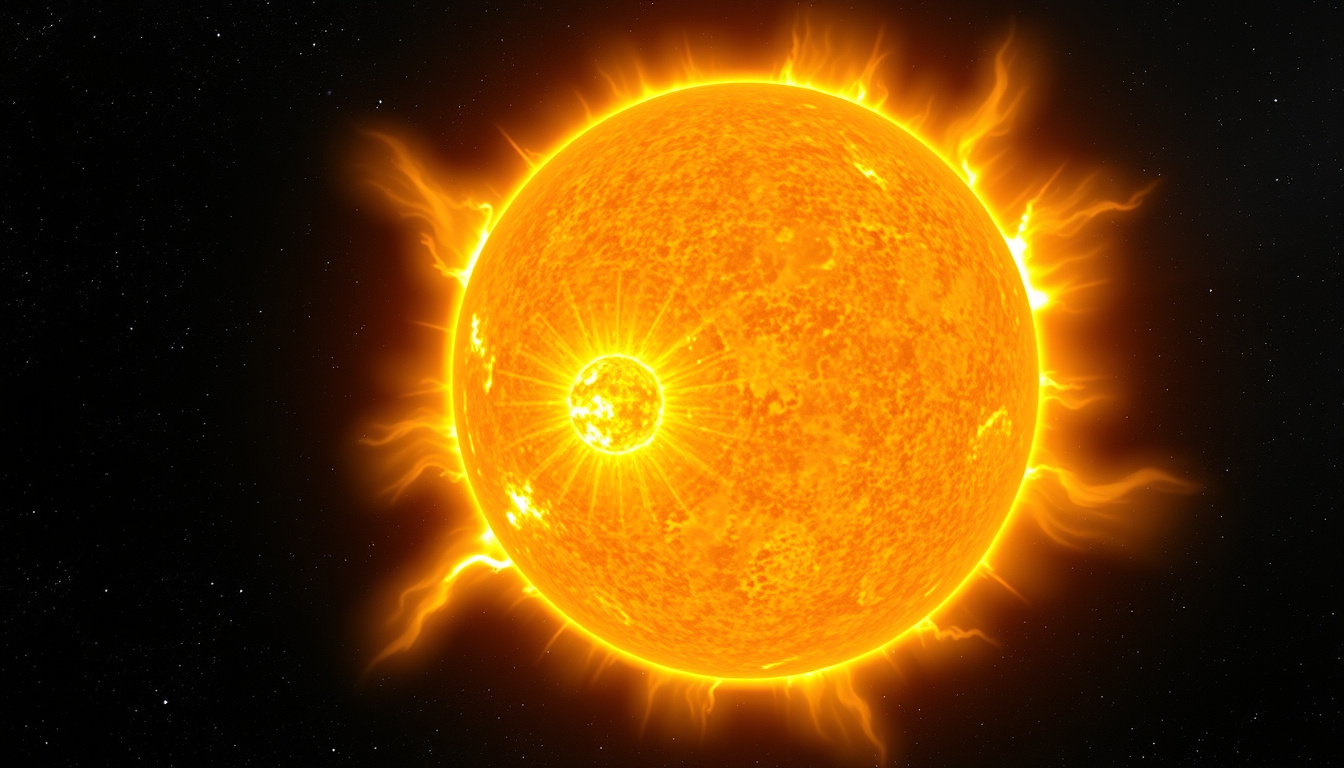
The Sun radiates energy at extraordinary temperatures that vary dramatically across its layers. From the searing heat of its core to the mysteriously hotter outer atmosphere, solar temperatures have fascinated scientists and curious observers for centuries. Understanding these temperatures helps explain how our star powers itself and why it behaves the way it does.
Temperature measurements across the Sun’s structure range from approximately 5,800 Kelvin at the visible surface to roughly 15 million Kelvin at the core. This gradient reveals the complex physics operating within our nearest star and drives phenomena that affect entire solar systems. Whether measured in Celsius, Fahrenheit, or Kelvin, these figures represent some of the most extreme conditions found in nature.
How Hot is the Surface of the Sun?
The Sun’s visible surface, called the photosphere, maintains an average temperature of approximately 5,800 Kelvin (about 5,500 degrees Celsius or 9,900 degrees Fahrenheit). This layer spans roughly 500 kilometers and represents the region where sunlight escapes into space. Unlike a uniform surface, the photosphere displays granulation patterns caused by convection currents of hot and cooler gas beneath.
Temperature varies considerably across this outer layer. Some regions reach 6,000 degrees Celsius while others cool to around 4,500 degrees. These cooler patches, known as sunspots, can drop to 3,000 to 4,000 degrees Celsius, appearing darker against the hotter surroundings.
The photosphere represents only 300 miles (500 kilometers) of depth—remarkably thin given the Sun’s 435,000-mile radius. This thin layer marks the boundary between the Sun’s opaque interior and the transparent space through which light travels to reach Earth.
Overview of Solar Layers and Temperatures
Key Facts About Solar Surface Temperature
- The photosphere averages 5,800 Kelvin, roughly 6,000 times hotter than Earth’s average surface temperature of 288 Kelvin
- Sunspots appear darker because they reach temperatures of 3,000–4,000°C—significantly cooler than surrounding areas
- The visible surface is only about 500 kilometers thick despite the Sun’s enormous size
- Temperature varies from 4,500°C in cooler regions to 6,000°C in hotter zones
- Granulation patterns on the photosphere result from convective motion of hot gas beneath the surface
- The photosphere represents the boundary where sunlight becomes visible as it escapes into space
Solar Layer Temperature Comparison
| Solar Layer | Temperature (Kelvin) | Temperature (Celsius) | Temperature (Fahrenheit) |
|---|---|---|---|
| Core | ~15,700,000 K | ~15,700,000°C | ~28,260,000°F |
| Radiative Zone (base) | ~7,000,000 K | ~7,000,000°C | ~12,600,000°F |
| Radiative Zone (top) | ~2,000,000 K | ~2,000,000°C | ~3,600,000°F |
| Convective Zone | ~2,000,000 K to ~5,800 K | ~2,000,000°C to ~5,500°C | ~3,600,000°F to ~9,900°F |
| Photosphere (average) | ~5,800 K | ~5,500°C | ~9,900°F |
| Chromosphere | ~4,500 K to ~25,000 K | ~4,000°C to ~25,000°C | ~7,200°F to ~45,000°F |
| Corona | ~1,000,000 K to ~2,000,000 K | ~1,000,000°C to ~2,000,000°C | ~1,800,000°F to ~3,600,000°F |
| Sunspots | ~3,300 K to ~4,500 K | ~3,000°C to ~4,000°C | ~5,400°F to ~7,200°F |
How Hot is the Sun’s Core?
The Sun’s core represents the most extreme temperature environment in our solar system. Pressure and density reach such intensity that nuclear fusion occurs at a rate of 600 million metric tons per second, converting hydrogen atoms into helium. This process generates the energy that eventually reaches Earth as sunlight.
Core temperature reaches approximately 15 million Kelvin (about 15 million degrees Celsius or 27 million degrees Fahrenheit). Density at the center measures approximately 160,000 kilograms per cubic meter—roughly 13 times the density of solid iron under Earth conditions. At these temperatures, matter exists in a plasma state where electrons strip from atomic nuclei.
The Sun converts approximately 600 million metric tons of hydrogen into helium every second. This energy, generated in the core, takes roughly one million years to bubble up through the radiative and convective zones before escaping as sunlight at the photosphere.
Understanding Core Temperature Data
Scientists determine core temperature through models based on observed solar mass, luminosity, and fusion reaction rates. Direct measurement remains impossible due to the opaque layers above the core, which prevent observation of its interior. However, these models consistently predict temperatures around 15 million Kelvin.
The fusion process powers the Sun and creates elements heavier than hydrogen through subsequent reactions. This energy gradually works outward through radiation and convection until it escapes as the light that illuminates Earth each day.
How Hot is the Sun in Celsius, Fahrenheit, and Kelvin?
Different temperature scales provide varying perspectives on solar heat. Kelvin represents the scientific standard, measuring absolute temperature from absolute zero. Celsius divides the interval between water’s freezing and boiling points into 100 degrees, while Fahrenheit uses a different scale based on historical reference points.
Temperature Conversions Across Solar Layers
| Location | Kelvin | Celsius | Fahrenheit |
|---|---|---|---|
| Core | ~15,700,000 K | ~15,699,727°C | ~28,259,940°F |
| Photosphere (average) | ~5,800 K | ~5,527°C | ~9,980°F |
| Corona | ~1,000,000–2,000,000 K | ~999,727–1,999,727°C | ~1,799,940–3,599,940°F |
Why Temperature Scales Matter
Kelvin avoids negative numbers and aligns with scientific calculations involving energy and state changes. At 0 K, molecular motion ceases entirely. The Sun’s core at 15 million K represents energy states vastly beyond everyday experience.
Celsius and Fahrenheit prove more intuitive for comparisons to Earth temperatures. Earth’s average surface temperature of 288 K translates to approximately 15°C or 59°F—roughly 400 times cooler than the Sun’s photosphere. Such comparisons help contextualize solar heat for general audiences.
How Hot is the Sun? Explanation for Kids
Imagine lighting a campfire where the flames never go out and burn millions of times hotter than the hottest fires on Earth. That’s the Sun! Our star is so hot that if you could stand on its surface, you would vaporize instantly—not just catch fire.
The Sun has different layers, like an onion. The outside layer feels like an oven set to about 10,000 degrees—hot enough to bake a million pizzas in a single second. But inside, where the Sun makes its energy, temperatures reach 15 million degrees—thousands of times hotter than the outside.
The Sun is dangerous to observe directly. Never look at the Sun without proper solar filters—looking at our star without protection can cause permanent eye damage within seconds.
The Sun Always Burns the Same
The Sun doesn’t get cooler at night because it doesn’t have night. Earth rotates, so different parts face the Sun at different times, but the Sun itself stays the same temperature constantly. Even the side of Earth facing away from the Sun receives the same solar heat as always.
Scientists measure solar temperature using special telescopes and instruments that analyze the light coming from the Sun. They study how different elements glow when heated to specific temperatures, helping them determine how hot each layer really is.
Temperature Paradox: Why the Corona is Hotter Than the Surface
One of the most puzzling aspects of solar physics involves the relationship between the photosphere and the corona. The visible surface maintains temperatures around 5,800 K, yet the corona above it reaches 1 to 2 million Kelvin—dramatically hotter than the layer it surrounds.
This temperature inversion contradicts everyday experience, where heat typically decreases with distance from a source. Scientists have proposed several explanations, with nanoflares emerging as a leading theory. These tiny explosions occur across the solar surface, each releasing energy equivalent to one-billionth of a regular solar flare.
Nanoflares reach temperatures up to 18 million degrees Fahrenheit (approximately 10 million degrees Celsius). Millions occur across the Sun’s surface every second, collectively contributing to corona heating. This mechanism, combined with other factors like magnetic wave energy, helps explain why the Sun’s outer atmosphere vastly exceeds surface temperatures.
What Scientists Have Established
- Photosphere temperatures are precisely measured through direct observation and spectroscopy
- Corona temperatures reach 1-2 million Kelvin based on spectral analysis and space-based observations
- Nanoflares occur constantly across the solar surface, reaching extreme temperatures individually
- The temperature gradient from interior to exterior follows well-understood physical laws
What Remains Uncertain
- The exact contribution of each potential heating mechanism to corona temperature
- How nanoflares collectively transfer energy to the corona efficiently enough to maintain observed temperatures
- Whether other heating mechanisms operate alongside nanoflares
- The precise interaction between magnetic fields and plasma that drives solar heating
Measurement Methods and Detection Techniques
Scientists employ multiple techniques to determine solar temperatures across different layers. Each method provides complementary data that together create a comprehensive picture of solar conditions.
Spectroscopy represents the primary tool for temperature determination. Elements emit light at specific wavelengths when heated, and analyzing these emission patterns reveals the temperature of the gas producing them. Different spectral lines correspond to different temperature ranges, allowing precise measurements.
Direct observation enables photosphere temperature measurements from Earth’s surface and space-based platforms. The Solar Dynamics Observatory and other spacecraft provide continuous monitoring of solar conditions, including temperature variations across different regions.
Solar eclipses offer unique opportunities to observe the chromosphere and corona. When the Moon blocks the photosphere, these normally invisible layers become visible, allowing direct measurement of their temperatures through specialized instruments.
The Sun’s Temperature Across Time
The Sun’s temperature has evolved significantly over its 4.6 billion-year history. Understanding this evolution helps scientists predict future changes and understand stellar development in general.
- Formation (4.6 billion years ago): The Sun coalesced from a collapsing cloud of gas and dust, heating rapidly as gravitational energy converted to thermal energy. Nuclear fusion ignited once core temperatures reached sufficient levels.
- Pre-main sequence: The young Sun contracted and heated, eventually reaching conditions stable enough for sustained hydrogen fusion. Core temperatures increased as the star settled into its main sequence phase.
- Main sequence (present): The Sun currently burns hydrogen in its core at approximately 15 million Kelvin. This phase will continue for approximately 5 billion more years.
- Red giant phase (future): As hydrogen fuel depletes, the Sun will expand and its surface layers will cool while the core heats further. Surface temperatures may drop to around 3,000 Kelvin while core temperatures climb higher.
- Post-red giant: Following eventual planetary nebula and white dwarf formation, remnant core temperatures will gradually cool over billions of years.
Solar Temperature in Context
Comparing solar temperatures to familiar objects and celestial bodies provides perspective on their extreme nature. Earth’s average surface temperature of 288 K seems modest compared to the Sun’s photosphere at 5,800 K—a difference of approximately 6,000 times.
The Moon experiences temperature extremes ranging from approximately 120 K during lunar night to 390 K during lunar day. Even at its hottest, lunar surface temperature falls far short of the Sun’s coolest visible regions.
Earth’s core reaches approximately 5,000 to 6,000 K—roughly comparable to the Sun’s photosphere. This parallel illustrates how extreme conditions within planets, while impressive, still fall short of stellar interiors. The Sun’s core temperature exceeds Earth’s core temperature by a factor of approximately 2,500.
For those interested in observing the night sky, checking local conditions can help plan stargazing sessions. The Night Sky Tonight resource provides updated information on celestial visibility and optimal observation times.
What Scientists Say About Solar Temperature
The Sun’s photosphere is surprisingly cool compared to the solar corona above it—a temperature inversion that remains one of the most active puzzles in solar physics.
Energy generated in the Sun’s core takes approximately one million years to reach the photosphere, where it finally escapes as the sunlight we receive.
Researchers continue investigating the mechanisms that drive corona heating through ground-based observatories and space missions. NASA’s Solar Dynamics Observatory provides continuous data on solar atmospheric conditions, while spectroscopic analysis from multiple wavelengths continues to refine temperature measurements across all layers.
Summary: Understanding Solar Temperatures
The Sun’s temperatures span an extraordinary range from 15 million Kelvin at the core to approximately 5,800 K at the visible surface. The corona, despite being farther from the heat source, reaches 1 to 2 million Kelvin—a phenomenon scientists attribute to nanoflares and related heating mechanisms. These temperatures, whether measured in Celsius, Fahrenheit, or Kelvin, represent some of the most extreme conditions in our solar system and drive the space weather that affects Earth and other planets.
Frequently Asked Questions
How hot is the Sun at night?
The Sun doesn’t experience night—Earth’s rotation simply changes which side faces the Sun. Solar temperatures remain constant regardless of whether a particular location on Earth experiences daylight or darkness.
How hot is the Sun right now?
Current measurements indicate the photosphere maintains approximately 5,800 K, the core remains around 15 million K, and the corona holds at 1-2 million K. These values fluctuate slightly but remain within established ranges.
Is the Sun’s core the hottest part?
The core is the hottest region where fusion occurs, but energy concentrations in nanoflares may momentarily exceed core temperatures in localized regions of the corona.
How do scientists measure the Sun’s temperature?
Scientists use spectroscopy to analyze light emitted by heated elements, direct observation through specialized telescopes, and measurements during solar eclipses when the chromosphere and corona become visible.
Why is the corona hotter than the photosphere?
The exact mechanism remains under active research, but scientists believe nanoflares—tiny explosions occurring across the solar surface—contribute significantly to corona heating.
How does solar temperature compare to Earth?
The Sun’s photosphere at 5,800 K is approximately 6,000 times hotter than Earth’s average surface temperature of 288 K, making direct comparison difficult given the immense difference.

Henry Wallace is Managing Editor at NewsPrism.co.uk, running the daily news list and covering UK and world affairs.