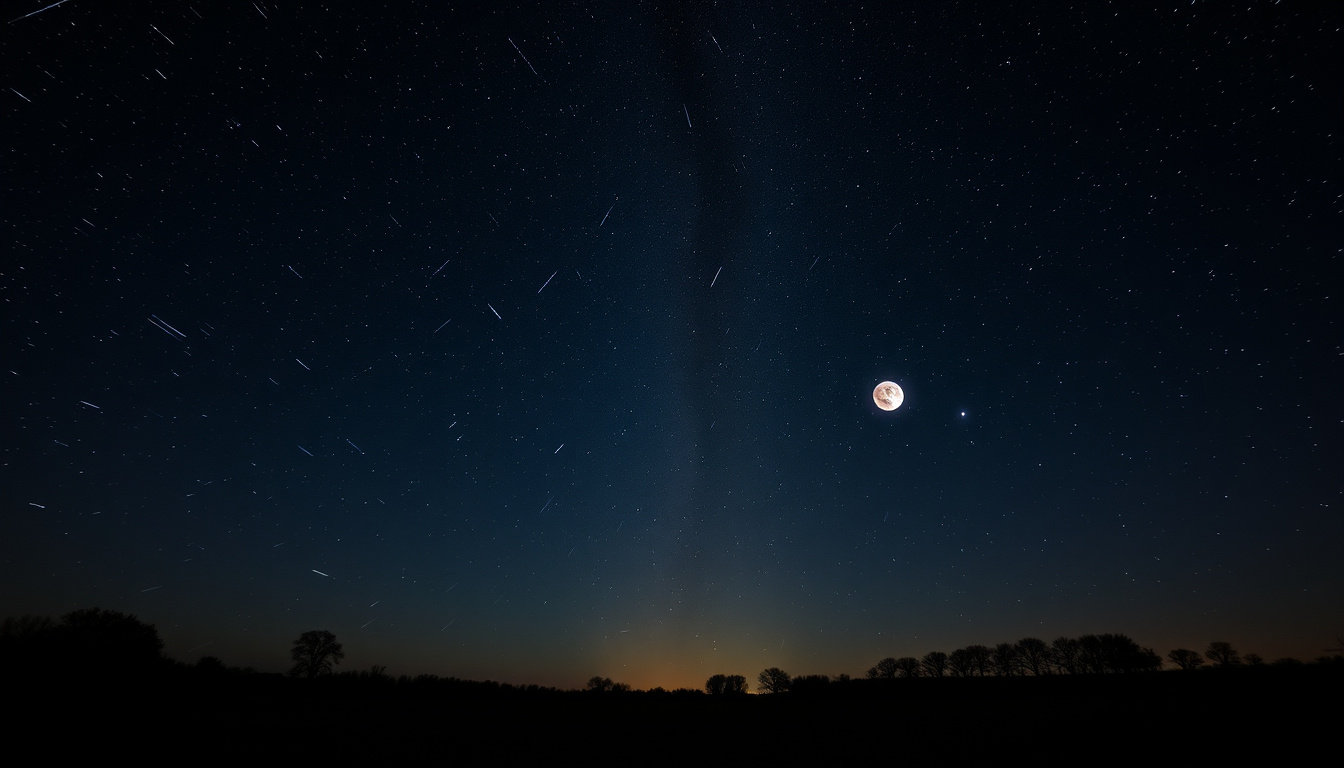
April 22, 2026 offers exceptional stargazing conditions, with the Lyrid meteor shower reaching its peak and multiple bright celestial objects gracing the evening sky. From prominent planets to seasonal constellations, tonight’s sky provides opportunities for both casual observers and dedicated astronomy enthusiasts to witness the cosmos in action.
The spring night sky this week presents a compelling mix of planetary visibility and astronomical events. Jupiter commands attention in the western sky, while Venus sparkles as the brightest object after sunset. The Lyrid meteor shower, one of the oldest known annual meteor displays, reaches its maximum activity in the predawn hours, offering dark-sky observers up to 20 meteors per hour under ideal conditions.
Whether you’re checking visibility from the United Kingdom or elsewhere in the Northern Hemisphere, understanding what’s overhead requires knowing which objects are visible, when they appear, and where to find them. This guide synthesises current astronomical data to help you plan your evening of skywatching.
What planets are visible tonight from my location?
Several planets become observable as darkness falls this evening, with Jupiter and Venus standing out as the most prominent celestial neighbours. Understanding their positions helps observers maximise their viewing experience regardless of light pollution levels.
Visible Planets
Jupiter and Venus dominate the western sky after sunset, with Mercury at its brightest annual visibility
Key Constellations
Gemini sits high overhead featuring Castor and Pollux, while Pleiades makes its final spring appearance
Moon Phase
Waxing crescent moon near Jupiter on April 21-22, providing minimal interference for meteor viewing
Notable Events
Lyrid meteor shower peak delivers up to 20 meteors per hour in predawn darkness
Quick facts for tonight’s skywatching
- Jupiter appears brighter than any star except Venus, positioned in constellation Gemini
- Venus ranks as the brightest object in the night sky, sometimes mimicking aircraft landing lights
- Mercury reaches its maximum brightness for 2026 during April
- The waxing crescent moon will pair visually with Jupiter on April 21 and 22 evenings
- Sirius, the sky’s brightest star overall, sits low in the southwest
- The Pleiades cluster begins its seasonal disappearance this month
Tonight’s celestial visibility snapshot
| Object | Visibility | Best Time | Location Note |
|---|---|---|---|
| Venus | Highly prominent | After sunset | Western sky, brightest object |
| Jupiter | Very bright | After sunset | High in western sky, Gemini |
| Mercury | Bright for Mercury | Twilight hours | Low western horizon |
| Sirius | Bright | Evening | Low southwest |
| Pleiades | Fading visibility | Early evening | Very low west, last month |
| Gemini | Prominent | All evening | High overhead |
Allow approximately 20 minutes for your eyes to adapt to darkness before attempting to observe fainter objects like the Pleiades or meteor trails. This adaptation significantly improves your ability to detect subtle celestial features.
Interactive night sky map for tonight
Digital sky mapping tools have transformed amateur astronomy, allowing observers to generate personalised charts based on their exact location and local time. These applications compile astronomical data to show precise rise and set times for planets, stars, and other objects.
For accurate, location-specific sky charts, Stellarium Online and TheSkyLive provide interactive maps that update in real-time. These tools accommodate elevation differences and atmospheric conditions that affect visibility, particularly for objects near the horizon.
When selecting a sky mapping application, consider whether it includes your local horizon obstructions, moon phase integration, and predicted atmospheric seeing conditions. Some platforms offer augmented reality features that overlay constellation lines and object names onto your phone camera view, simplifying identification for beginners.
Choosing the right mapping tool for your needs
Free platforms generally provide sufficient detail for casual skywatchers seeking to identify major planets and constellations. Subscription-based services typically offer additional features including satellite tracking, detailed ephemeris data, and community observation logs that enhance serious astronomical pursuits.
Most digital sky maps require internet connectivity to generate accurate location-based charts. Downloading offline star catalogues before heading to darker observing sites ensures uninterrupted functionality in areas with limited cellular coverage.
What is happening in the sky tonight?
Tonight’s astronomical programme centres on the Lyrid meteor shower, which reaches its annual peak during the early morning hours of April 22. This meteor shower, documented since 687 BCE, originates from debris shed by Comet Thatcher and produces bright, fast-moving streaks that often leave persistent trains.
Lyrid meteor shower peak details
The shower’s maximum activity occurs between midnight and dawn, with the predawn hours offering optimal viewing under moonless conditions. Observers in dark-sky locations away from urban light pollution can expect between 10 and 20 meteors per hour at peak, though brighter moons can reduce visible rates significantly.
Unlike some meteor showers that favour specific hemispheres, the Lyrids remain accessible to observers across the Northern Hemisphere including the United Kingdom. The radiant point rises in the east around 10 pm local time, climbing higher through the night as Earth rotates into the predawn darkness.
Spring constellation season
Spring constellations transition across the evening sky, with Leo rising in the east as winter patterns descend toward the horizon. Gemini remains well-positioned high overhead throughout the evening, making it an ideal starting point for constellation hopping sessions that can extend toward Orion’s return in autumn.
The Twins, Castor and Pollux, frame Jupiter on these April evenings, creating a distinctive asterism that aids navigation for less experienced stargazers. The twins’ proximity to the ecliptic also places them within reach of several planetary wanderers throughout the year.
Meteor shower predictions carry inherent uncertainty due to the unpredictable nature of debris density within comet trails. While the Lyrid peak typically produces reliable displays, occasional bursts of up to 100 meteors per hour have been recorded, making vigilance worthwhile even outside predicted maximum windows.
What is the bright white star visible tonight?
Identifying bright objects in the night sky requires distinguishing between stars, planets, and occasionally spacecraft. Tonight features several candidates for the “bright white star” description, with Venus and Jupiter most frequently mistaken for stellar objects by casual observers.
Venus: the evening’s brightest object
Venus consistently ranks as the brightest natural object in Earth’s night sky after the Moon. Its proximity to the Sun and reflective cloud cover generate an apparent magnitude that typically exceeds all stars, making it unmistakable in the post-sunset western sky.
Observers sometimes describe Venus as appearing bright enough to mimic aircraft landing lights, particularly when viewed near the horizon where atmospheric refraction creates dramatic twinkling. The planet’s phases, observable through modest telescopes, mirror lunar quarter cycles throughout its 584-day orbital period.
Jupiter: planetary king
Jupiter exceeds all stars in brightness except Venus, though it remains distinguishable from true stars by its steady glow rather than twinkling. The planet’s position within Gemini places it near Castor and Pollux, the Twins’ bright star pair, creating a recognisable trio that dominates the western evening sky.
Unlike stars that occupy fixed positions relative to Earth’s rotation, planets migrate through the zodiac over weeks and months. Jupiter’s current residency in Gemini will extend through spring before it begins descending toward the horizon in summer months.
Sirius: the sky’s brightest true star
When observers report a “bright white star” in the southwest, they often glimpse Sirius, the brightest star in the entire sky. Located in Canis Major, Sirius shines with a luminosity approximately 25 times greater than our Sun, though its 8.6-light-year distance dims its apparent brightness considerably.
April evenings mark one of the final opportunities to observe Sirius before its descent behind the southwestern horizon makes it increasingly difficult to catch. The star’s characteristic blue-white colour and pronounced scintillation near the horizon add to its distinctive appearance.
Where to find comets tonight from my location?
Comet visibility varies considerably based on current astronomical activity and the brightness of individual objects. Unlike planets, comets do not appear on predictable schedules, and their visibility depends on recent approaches to both the Sun and Earth.
According to NASA’s night sky planning resources, comet observations require checking current astronomical bulletins for active targets. Several comet discovery services maintain updated lists of observable objects, their predicted brightness, and optimal viewing directions.
For current comet positions, consulting real-time astronomy databases provides the most accurate location information. These resources incorporate orbital calculations that account for the unpredictable activity levels comets display as they approach solar heating.
Resources for tracking comets
Professional and amateur astronomy networks maintain current comet reports that amateur telescopes and binoculars can follow. The NASA Skywatching programme provides accessible guidance for observing major celestial events, though specific comet tracking typically requires dedicated astronomy platforms.
Observers should note that comet brightness predictions frequently change as objects respond unpredictably to solar heating. A comet predicted at magnitude 8 might brighten significantly or fail to achieve expected visibility depending on surface activity and dust production rates.
Comets requiring telescopic observation benefit from dark adaptation techniques similar to those used for meteor viewing. Avoid looking at phones or bright screens for at least 20 minutes before attempting to locate faint comets near the limit of your instrument’s reach.
Tonight’s evening skywatching timeline
Planning your astronomical observing session around predictable celestial events helps maximise your time under the stars. The following sequence outlines tonight’s key viewing opportunities from dusk through midnight.
- Sunset (approximately 7:45 pm local) — Venus becomes visible low in the western sky as civil twilight ends
- 8:00-9:00 pm — Jupiter emerges prominently in Gemini, remaining observable for several hours
- 9:00-10:00 pm — The Pleiades cluster sits very low in the west; last opportunity before seasonal disappearance
- 10:00 pm onwards — Sirius descends toward southwestern horizon, Leo fully risen in eastern sky
- 11:00 pm-midnight — Lyrid meteor shower radiant climbs higher; rates increase as Earth rotates into prime viewing position
- 2:00-4:00 am (April 22) — Peak Lyrid activity window; predawn darkness offers optimal meteor visibility
- Dawn — Mercury appears at maximum brightness for the year on eastern horizon
Precise timing varies by geographic location, particularly latitude and longitude differences affecting constellation visibility angles. Observers in northern Scotland will experience slightly different sky progression than those in southern England.
Understanding visibility predictions and their limits
Astronomical visibility predictions provide reliable guidance for major objects like planets and meteor shower peaks, though certain factors introduce inherent uncertainty into any forecast.
What predictions can tell you with confidence
Planetary positions relative to Earth follow predictable orbital mechanics that astronomical calculations can determine with precision spanning centuries. The locations of Jupiter, Venus, and Mercury for any given evening represent established scientific fact rather than estimation.
Constellation positions relative to Earth remain consistent and calculable, allowing precise identification of when specific star patterns become visible from any given location. Meteor shower peak dates and typical rates derive from accumulated observations spanning decades of recording.
Where uncertainty remains
Local weather conditions introduce the most significant unpredictable variable affecting any skywatching session. Cloud cover, atmospheric turbulence, and humidity levels can completely prevent observation of otherwise accessible celestial events regardless of calculated visibility.
Individual meteor counts during shower peaks vary considerably from averages, with observers sometimes witnessing significantly higher or lower rates than predicted. This natural variation stems from the uneven distribution of debris within comet trails.
| Established information | Uncertain or variable factors |
|---|---|
| Planetary positions and brightness | Local weather and cloud cover |
| Constellation visibility windows | Individual meteor counts |
| Meteor shower peak dates | Atmospheric seeing conditions |
| Moon phase and position | Light pollution impact locally |
Seasonal context: why spring skies differ
Spring constellations occupy distinct positions compared to winter and summer patterns, creating unique observing opportunities specific to this transitional season. Earth’s orbital position places different portions of the Milky Way core visible during evening hours.
April evenings feature a sky midway between the winter constellations including Orion and the summer display highlighted by Scorpius and Sagittarius near the galactic centre. This positioning makes planetary observations particularly favourable as major worlds align along the ecliptic plane.
The waxing crescent moon this week provides minimal interference for meteor viewing while still offering sufficient illumination for lunar landscape observation with binoculars. This balance between moonlight and darkness occurs only during specific lunar phases, making the current period optimal for combined viewing sessions.
The Pleiades’ low position in April marks the beginning of its seasonal absence from evening skies. Observers wishing to view this cluster should do so soon, as it won’t reappear in the evening sky until autumn when it returns with the transition toward winter constellations.
Authoritative sources for tonight’s skywatching
Reliable astronomical information derives from established institutions with demonstrated expertise in observational astronomy and spacecraft missions. Several organisations maintain public-facing resources designed specifically for amateur skywatchers.
The Lyrid meteor shower peaks before dawn on the morning of April 22, with the best viewing conditions occurring in the predawn hours when you’ll have a dark and moonless sky.
— EarthSky Tonight
EarthSky provides regular updates on visible planets and celestial events, offering accessible guidance for observers ranging from beginners to experienced astronomers. Their monthly skywatching guides synthesise data from multiple professional sources into practical viewing recommendations.
NASA’s Skywatching programme extends the organisation’s scientific expertise to public observation. Their resources include guidance for major events, spacecraft mission updates, and seasonal constellation highlights designed for northern hemisphere observers.
Plan your viewing session tonight
Tonight’s combination of planetary visibility, meteor shower peak, and seasonal constellation positioning creates an exceptional opportunity for skywatching across skill levels. Jupiter and Venus provide immediate visual impact upon stepping outside, while the Lyrid peak rewards those willing to brave predawn darkness with streaking meteors.
For additional guidance on planning outdoor activities around weather conditions, explore the 14-day forecast and outlook for Palma Nova to understand how atmospheric conditions might affect visibility in popular European observing locations. Proper preparation transforms good conditions into excellent viewing experiences.
Frequently asked questions
What planets are visible tonight from my location in the UK?
From UK locations tonight, Jupiter and Venus appear prominently in the western sky after sunset. Mercury reaches peak visibility during April and becomes observable in twilight hours.
What is the bright white star visible tonight?
Venus appears as the brightest object in tonight’s night sky, often appearing whiter than any star. Jupiter ranks second, outshining all stars except Venus when observing from most locations.
What is happening in the sky tonight?
The Lyrid meteor shower reaches its peak tonight, with optimal viewing occurring in the predawn hours of April 22. This annual shower can produce up to 20 meteors per hour under dark skies.
Can I see a comet tonight?
Active comet visibility varies by current astronomical activity. Checking real-time astronomy databases or NASA’s Skywatching resources provides current information on observable comets requiring telescopic observation.
What is the current moon phase tonight?
The moon appears as a waxing crescent tonight, positioned near Jupiter on April 21 and 22 evenings. This phase provides minimal moonlight interference for meteor viewing while remaining observable with the naked eye.
Where can I find a night sky map for my location?
Interactive sky maps at Stellarium Online and TheSkyLive generate personalised charts based on your exact coordinates, showing precise rise and set times for visible objects.
What constellation is visible tonight?
Gemini sits high overhead throughout the evening, featuring the bright twin stars Castor and Pollux. Leo rises prominently in the east, while Orion begins its descent toward the western horizon.

Henry Wallace is Managing Editor at NewsPrism.co.uk, running the daily news list and covering UK and world affairs.