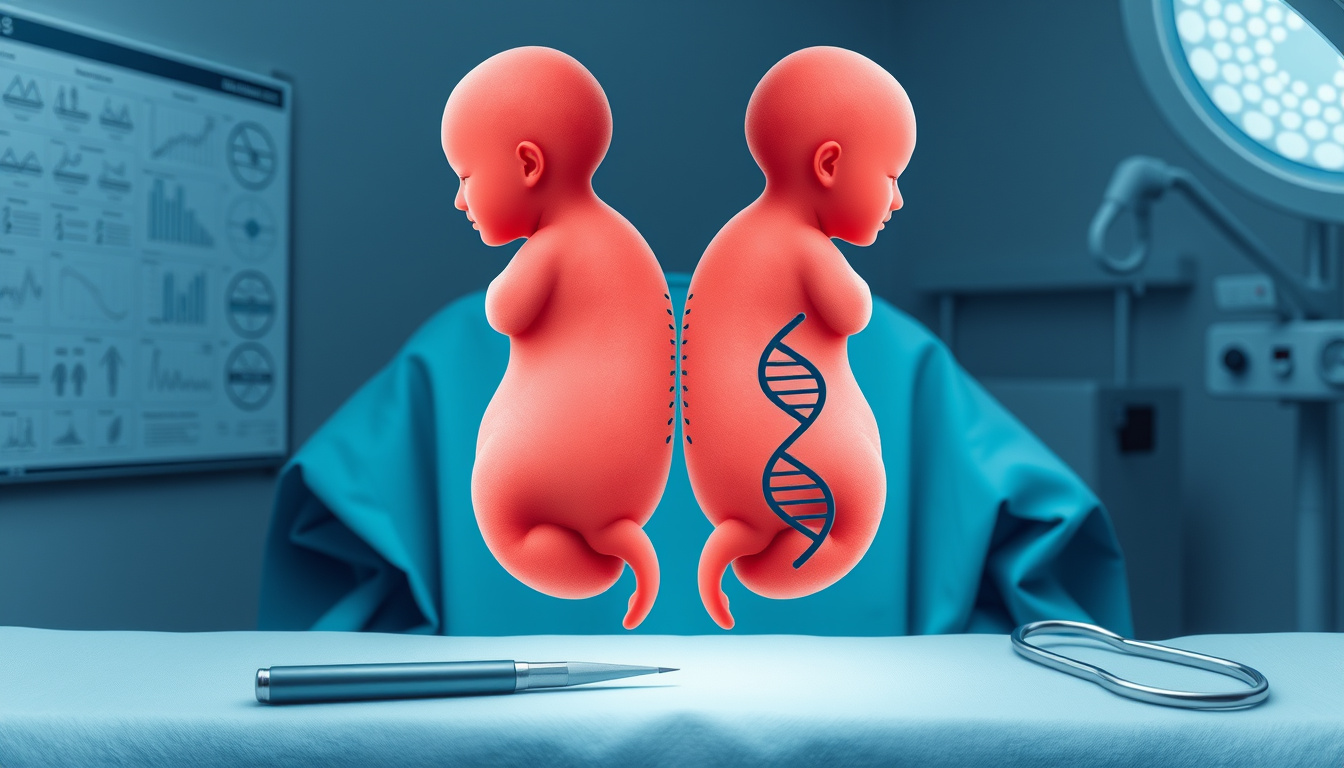
Conjoined twins are a rare and medically complex phenomenon. They occur when identical twins are physically connected at birth because the embryo does not fully separate early in development. The leading explanation is incomplete fission, or less commonly, secondary fusion. Prognosis depends heavily on where they are joined and whether they share vital organs, especially the heart.
Stories of conjoined twins have long captured public attention, from historical figures to modern cases covered by news outlets and documentaries. Understanding the medical reality behind these stories requires looking at the causes, classifications, surgical possibilities, and outcomes.
What causes conjoined twins?
Key Facts at a Glance
- Definition: Twins physically connected at birth
- Incidence: ~1 in 50,000 to 200,000 births
- Survival: ~40% are stillborn; ~35% survive to separation surgery
- Separation success: Depends on shared organs, often complex surgery
- Conjoined twins arise from a single fertilized egg that fails to fully separate after day 12 of gestation.
- Approximately 70% are female, and most are identical twins.
- Types are named by the site of fusion (e.g., thoracopagus, omphalopagus).
- Separation surgery is a major undertaking; many twins remain conjoined if separation is too risky.
- Famous living conjoined twins like Abby and Brittany Hensel have shown it is possible to lead an independent, fulfilled life while conjoined.
| Category | Fact |
|---|---|
| Incidence | 1 in 50,000 to 200,000 live births |
| Gender | ~70% female |
| Cause | Incomplete splitting of a single fertilized egg |
| Common type | Thoracopagus (chest fusion) ~40% of cases |
| Stillbirth rate | ~40-60% die before or shortly after birth |
| Famous pair | Abby & Brittany Hensel (dicephalic, born 1990) |
| First successful separation | 1955, Leonard and Paul (thoracopagus, UK) |
The main embryologic theories are partial fission (the embryo splits incompletely) and secondary fusion (two embryonic structures fuse later). According to the Cleveland Clinic, the relevant developmental disruption occurs when the embryo splits around 12 to 14 days after fertilization rather than forming two fully separate embryos. This timing is critical because it determines how the twins will be joined.
Conjoined twins are always monozygotic (identical) and therefore always the same sex. There is no known genetic or environmental trigger that reliably predicts the condition.
What are the types of conjoined twins?
Conjoined twins are commonly classified by the point of attachment. The main types include:
Thoracopagus
Joined at the chest; one of the most common forms, often involving the heart and liver. StatPearls reports thoracopagus accounts for about 18.5% of cases, while Wikipedia’s summary gives 28% — variation across datasets is common.
Omphalopagus / thoraco-omphalopagus
Joined at the abdomen or chest-to-abdomen region; may share liver and digestive organs. This type represents about 10% (StatPearls) to 18.5% (Wikipedia) of cases.
Craniopagus
Joined at the head or cranium; about 6% of cases (StatPearls) or 2% (CHOP). Separation is extremely challenging due to shared brain structures.
Other types
Pygopagus (buttocks), ischiopagus (pelvis), and rarer forms such as parasitic twins (heteropagus) are also described in clinical classifications. One hospital summary notes that about 75% of all conjoined twins are joined at the chest wall or upper abdomen, 23% at the hips or legs, and 2% at the head.
How many conjoined twins are there in the world?
Incidence estimates vary considerably. The range is roughly 1 in 50,000 to 1 in 200,000 births, with some sources narrowing this to 1 in 50,000 to 1 in 60,000. The variation stems from underreporting and the high rate of stillbirths — approximately 40% to 60% of conjoined twins are stillborn, and about 35% of liveborn infants die within 24 hours.
Long-term survival is rare. Historical survival rates are reported around 5% to 25%, while one clinical summary gives an overall survival rate of 7.5% and another review notes about 8% survive. After separation surgery, survival improves to about 60% (with one review citing 66.7%).
The wide range in incidence and survival figures reflects differences in data collection, classification systems, and medical advancements over time. No single number is universally accepted.
How are conjoined twins separated?
Whether surgery is possible depends mainly on what organs are shared, especially the heart and liver. If twins share a heart — particularly at the ventricular level — separation is often not possible or is extraordinarily rare. The Children’s Hospital of Philadelphia (CHOP) states it has successfully separated 32 pairs since 1957, and that successful division with a shared heart is usually not possible.
Pre-surgical planning
Prenatal imaging, postnatal MRI, and 3D modeling are used to map anatomy and plan surgery. Some cases use tissue expansion before surgery to increase available skin for closure, as highlighted in the case of Amari and Javar at CHOP.
Surgical outcomes
Older summaries report that only about 25% of surviving conjoined twins live long enough to become surgical candidates. For those who undergo surgery, survival is around 60-66.7%. UF Health notes that there have been only about 250 successful surgical separations in which one or both twins survived long term.
Who are conjoined twins Abby and Brittany Hensel?
Abby and Brittany Hensel are dicephalic conjoined twins born in 1990. They are among the most famous living conjoined twins, known for their public appearances and documentaries that show them leading active lives despite sharing a single body. They have not publicly confirmed having children. Their case illustrates that some conjoined twins can choose to remain conjoined rather than risk separation.
Other notable cases include Lori and George Schappell, Rosa and Josefa Blazek, and the historical Chang and Eng Bunker, who gave rise to the term “Siamese twins.” The story of Ruby and Rosie, profiled by BBC in 2023, highlights modern successful separation with multidisciplinary care.
Media coverage often focuses on prenatal diagnosis, family counseling, ethical decisions about separation, and the multidisciplinary teams involved — from fetal medicine to pediatric surgery and nursing.
What are the key milestones in conjoined twin history?
- c. 1100 AD – Biddenden Maids (joined at shoulder, lived 34 years, England)
- 1811 – Chang and Eng Bunker (coined ‘Siamese twins’, lived 63 years, died hours apart)
- 1955 – First successful separation surgery (Leonard and Paul, UK)
- 1987 – Separation of Lakeberg twins (high-profile, controversial)
- 1990 – Birth of Abby and Brittany Hensel (dicephalic, survived to adulthood)
- 2000 – Separation of Egyptian twins (Ahmed and Mohamed, 50-hour surgery)
- 2023 – Ruby and Rosie (11-year-old twins, BBC profile, defying odds)
- 2024 – Azaria and Azora separated (shared liver, successful)
What do we know and what remains unclear about conjoined twins?
| Established information | Information that remains unclear |
|---|---|
| Conjoined twins are always identical (monozygotic). | Exact incidence varies widely due to underreporting and stillbirths. |
| They share the same genetic material and always same sex. | Long-term outcomes for separated twins (quality of life, psychological effects) are not extensively studied. |
| Fusion occurs in the first 2-3 weeks of embryonic development. | Whether conjoined twins can have separate children – possible but no widely documented cases. |
| Separation is possible only if twins have separate vital organs. | Mechanisms triggering incomplete splitting are not fully understood (no clear genetic or environmental cause). |
What is the medical, ethical, and cultural context of conjoined twins?
Conjoined twins challenge definitions of individuality and autonomy. Separation decisions involve heavy ethical considerations: weighing the risk of surgery against quality of life, parental consent, and the future well-being of the children. Media representation often sensationalizes the condition in horror movies or inspires through documentaries; accurate portrayal matters for public understanding.
Advances in prenatal imaging (ultrasound, MRI) allow early detection and planning. Multidisciplinary teams of surgeons, anesthesiologists, psychologists, and other specialists are essential for successful outcomes. Improved 3D modeling and virtual surgery planning are reducing risks. Greater societal acceptance and visibility of conjoined individuals in media and daily life continues to grow.
What are the trusted sources and key quotations about conjoined twins?
“Conjoined twins are a rare phenomenon, occurring in 1 in 50,000 to 200,000 births.” – Wikipedia
“Approximately 40% of conjoined twins are stillborn.” – CHOP
“Ruby and Rosie were born joined at the intestine and abdomen, now lead active lives.” – BBC (2023)
Key sources include the comprehensive Wikipedia overview, the Children’s Hospital of Philadelphia’s authoritative medical resource, the peer-reviewed StatPearls article on NCBI, BBC News for real-life case stories, and ITV News for coverage of the Azaria & Azora separation.
What is the future of conjoined twin care and research?
Improved 3D modeling and virtual surgery planning continue to reduce surgical risks. Better understanding of embryonic development may one day reveal prevention clues. Greater societal acceptance and visibility of conjoined individuals in media and daily life are expected. In-utero separation remains experimental. For now, the most important predictor of survival remains shared vital anatomy — especially the heart. Explore our complete guide to twin types for more background, or read about famous medical separations.
Frequently asked questions about conjoined twins
What movies feature conjoined twins?
Several movies, including ‘The Dark Half’ (1993), ‘Basket Case’ (1982), and documentaries like ‘Joined for Life’ (2023). The phrase ‘Siamese twins’ is used historically.
Do conjoined twins share thoughts or feelings?
Generally no; they have separate brains and consciousness, though they may share sensations if the nervous system is connected (rare).
Can conjoined twins have children?
It is biologically possible if reproductive organs are intact. Abby and Brittany Hensel have not publicly confirmed having children. Chang and Eng Bunker fathered 21 children.
What is the difference between Siamese twins and conjoined twins?
The term ‘Siamese twins’ originated from Chang and Eng Bunker (born in Siam, now Thailand). ‘Conjoined twins’ is the modern, medically preferred term.
Are conjoined twins always the same gender?
Yes, because they are monozygotic (identical) twins, sharing the same genetic sex chromosomes.
What is the survival rate for conjoined twins?
Approximately 40-60% are stillborn. Of liveborn twins, long-term survival is 5-25%, with about 60-67% surviving separation surgery.
Can conjoined twins feel each other’s pain?
If they share a nervous system (rare), pain may be felt by both. Typically they have separate nervous systems and do not share sensations.
What is the rarest type of conjoined twins?
Craniopagus (joined at the head) is among the rarest, comprising about 2-6% of cases. Heteropagus (parasitic) is also very rare.

Henry Wallace is Managing Editor at NewsPrism.co.uk, running the daily news list and covering UK and world affairs.