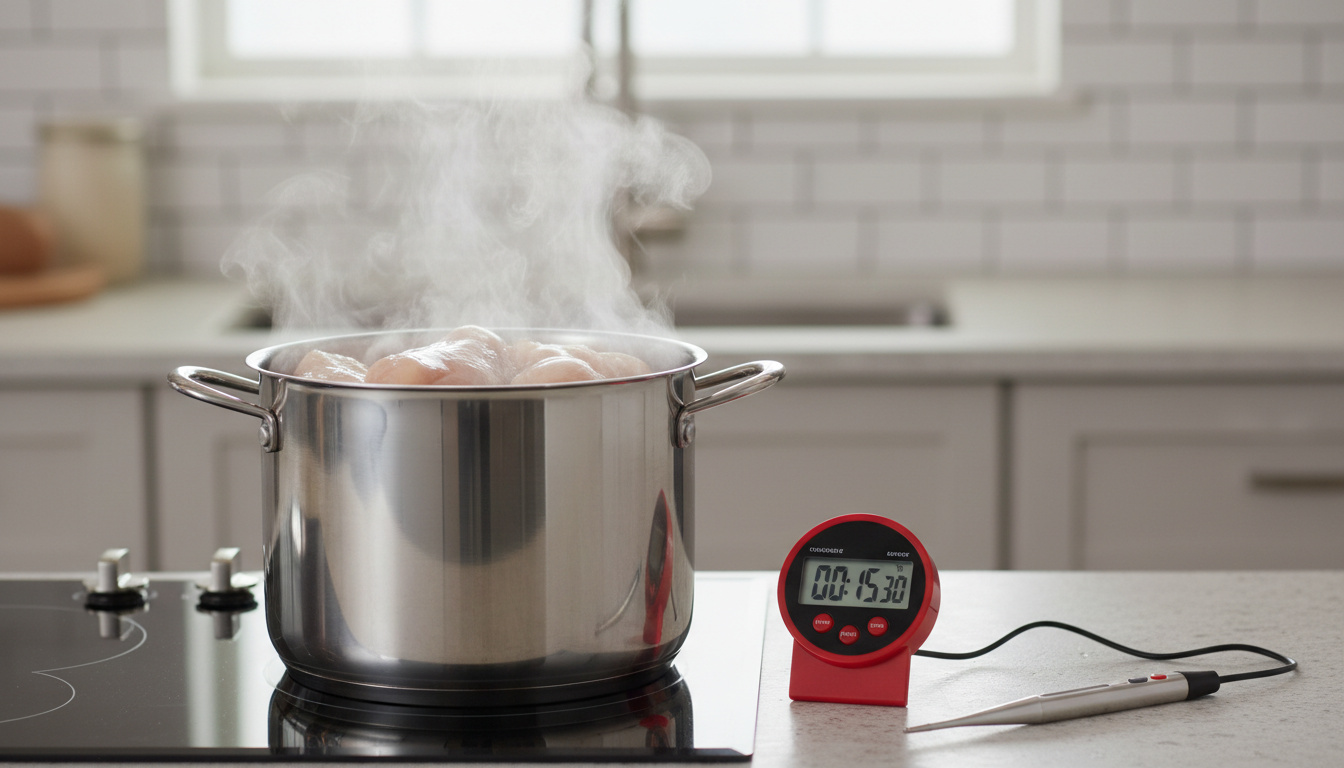
Boiling chicken breast delivers tender, versatile protein for salads, soups, and meal prep, but timing varies dramatically based on bone content, starting temperature, and thickness. While many home cooks rely on visual cues, food safety authorities emphasize that internal temperature—not the clock—determines when poultry is safe to eat.
Fresh boneless cuts may require as little as twelve minutes, while frozen bone-in portions can demand upwards of thirty-five minutes. The difference between juicy meat and a rubbery disaster often comes down to monitoring the simmer and verifying the USDA-recommended 165°F endpoint.
How Long Does It Take to Boil Chicken Breast?
12–20 minutes
30–40 minutes
+50% time
165°F (74°C)
- Time ranges assume 6–8 ounce portions at sea level; larger pieces require extension
- Frozen chicken requires approximately 50% longer cooking times than fresh equivalents
- Bone-in cuts retain moisture but need significantly more time due to thermal insulation
- Altitude above 3,000 feet may extend cooking times by 10–25%
- Only a calibrated food thermometer can confirm safety; color and texture vary significantly
- Overcooking begins once temperatures exceed 165°F, causing moisture loss and toughness
| Cut Type | State | Approximate Time | Internal Temp | Verification Notes |
|---|---|---|---|---|
| Boneless skinless (6–8 oz) | Fresh | 12–17 minutes | 165°F | Check thickest part |
| Boneless skinless (6–8 oz) | Frozen | 20–25 minutes | 165°F | Simmer after bringing to boil |
| Boneless skinless (8–10 oz) | Frozen | 25–30 minutes | 165°F | Larger pieces take longer |
| Bone-in skin-on | Fresh | 30+ minutes | 165°F | Depends on size and bone density |
| Bone-in | Frozen | 25–35+ minutes | 165°F | Longer than boneless; use thermometer |
| Cut in half (boneless) | Fresh | 7–8 minutes | 165°F | Reduces thickness for faster cooking |
How to Boil Chicken Breast Step by Step
Success requires controlling the simmer rather than maintaining a rolling boil, which toughens protein fibers and forces out moisture.
Preparation and Seasoning
Arrange breasts in a single layer at the bottom of a heavy-bottomed pot. Cover with 1.5 to 2 inches of cold water or unsalted broth, ensuring complete submersion. Add one teaspoon of kosher salt per quart of liquid to enhance flavor and help retain moisture during cooking.
The Simmering Process
Bring the liquid to a gentle boil over medium-high heat, then immediately reduce to a low simmer—small bubbles breaking the surface steadily. Aggressive boiling causes the meat to seize and turn rubbery. Maintain this gentle heat throughout cooking.
Insert an instant-read thermometer into the thickest portion of the breast, avoiding contact with bone. The display must reach 165°F (74°C) before removing from heat, according to USDA poultry guidelines. Color alone is unreliable; pink hues can appear even in fully cooked chicken due to myoglobin and pH variations.
Resting Before Serving
Transfer cooked breasts to a cutting board and tent loosely with foil. Allow five to ten minutes of resting time to permit juice redistribution. Cutting immediately releases moisture, resulting in dry meat.
How Long to Boil Chicken Breast for Shredding
Shredded chicken demands specific tenderness that falls apart under gentle pressure from forks. This texture develops when connective tissue breaks down completely without crossing into desiccation.
Timing for Tender Shreds
For 1.5 pounds of fresh boneless skinless breasts, maintain a simmer for approximately twenty minutes. Frozen batches require an additional three to five minutes. The meat should offer no resistance when probed with a fork.
The Hot Broth Rest
After reaching 165°F, remove the pot from heat but leave the chicken submerged in the hot liquid for an additional five minutes. This resting period allows the meat to reabsorb some moisture before shredding. Drain and shred using two forks or a stand mixer with a paddle attachment on low speed.
Shredded chicken prepared this way suits salads, tacos, casseroles, and meal prep containers, maintaining moisture for three to four days refrigerated.
Can You Boil Frozen Chicken Breast Safely?
Cooking frozen chicken directly eliminates the overnight thawing requirement while maintaining food safety, provided you extend cooking times appropriately and verify final temperatures.
Never attempt to speed the process with high heat. Frozen boneless skinless breasts (6–8 ounces) require twenty to twenty-five minutes of simmering, while larger frozen bone-in pieces may need thirty-five minutes or longer. The temperature verification process remains identical to fresh chicken.
Ice crystals within the muscle tissue act as insulation, creating temperature lag. The exterior may appear cooked while the center remains frozen. Check multiple spots with a thermometer to confirm 165°F throughout.
At elevations above 3,000 feet, water boils at lower temperatures, extending necessary cooking times by 10–25%. No specific adjustments were documented in available research, but testing internal temperature becomes even more critical.
Boiling Timeline by Stage
- Preparation (2 minutes): Place chicken in pot, cover with 1.5–2 inches water or broth, add seasonings.
- Heat to Boil (5–8 minutes): Medium-high heat until surface breaks into a rolling boil.
- Reduce to Simmer (Immediate): Lower heat to maintain gentle bubbles; cover partially.
- Cook Through (12–35 minutes): Boneless fresh: 12–17 min; Bone-in fresh: 30+ min; Frozen: add 50% time.
- Temperature Check (1 minute): Insert thermometer into thickest part; verify 165°F (74°C).
- Resting (5–10 minutes): Remove from heat, tent with foil, allow juices to redistribute.
Safety Facts: When Chicken is Done Boiling
Established Facts
- USDA mandates 165°F (74°C) internal temperature for all poultry
- Instant-read thermometers provide definitive safety confirmation
- Clear juices and white meat indicate thorough cooking
- Frozen chicken can be boiled safely with extended time
- Boiling destroys Salmonella and Campylobacter when temp threshold reached
Uncertain Variables
- Exact minutes vary by specific weight, thickness, and starting temperature
- Precise altitude adjustments above 3,000 feet not standardized
- Residual pinkness near bones does not always indicate undercooking
- Exact calorie retention rates compared to other cooking methods
Why Boil Chicken Breast? Pros and Context
Boiling offers distinct advantages for specific culinary applications. The moist-heat method produces uniformly tender protein ideal for chicken salad, green chili, and soup recipes where aggressive browning proves unnecessary. Unlike grilling or sautéing, boiling requires no added fats or oils, yielding a leaner finished product—approximately 243 calories per two-serving portion of skinless breast.
The technique also generates flavorful broth as a byproduct, usable for cooking rice or as a soup base. For fitness enthusiasts monitoring macronutrients, boiled chicken provides high protein content with minimal variables, unlike restaurant preparations with unknown butter or oil quantities. Pairing this preparation with strength training protocols such as the Bent Over Barbell Row – Form, Muscles Worked, Benefits supports muscle synthesis without excess caloric intake.
However, boiling does not develop Maillard reaction flavors—the browned, complex tastes achieved through roasting or searing. Applications requiring crisp textures or caramelized surfaces demand alternative methods.
Expert Sources and Guidelines
The USDA recommends a safe minimum internal temperature of 165°F (74°C) for all chicken, including boneless skinless or bone-in breasts, whether fresh or frozen, measured in the thickest part with a food thermometer to ensure food safety and kill harmful bacteria like Salmonella.
USDA Food Safety and Inspection Service
This standard aligns with FDA guidelines, which emphasize temperature verification over time-based assumptions. Both agencies note that color and texture indicators vary based on chicken age, feed, and processing methods, making thermometer use the only reliable safety metric.
Additional guidance from agricultural extension services confirms that simmering—rather than vigorous boiling—preserves moisture while achieving necessary lethality for pathogens. Culinary testing consistently supports these safety thresholds across various pot sizes and burner intensities.
What to Do After Boiling
Once cooled, store boiled chicken in airtight containers within two hours of cooking. Refrigerated portions remain safe for three to four days, while frozen batches maintain quality for up to four months. Slice for sandwiches, cube for Cacio e Pepe Recipe – Authentic Roman Technique adaptations with added protein, or shred for weekly meal prep. Reserve the cooking liquid for rice preparation or as a foundation for tomorrow’s soup.
Frequently Asked Questions
Can you boil chicken breast too long?
Yes. Extended boiling beyond the necessary time to reach 165°F causes protein fibers to tighten and squeeze out moisture, resulting in rubbery, dry meat. Always verify temperature rather than extending cook time arbitrarily.
How long should you boil chicken thighs?
Bone-in chicken thighs require approximately thirty to forty minutes of simmering, while boneless thighs need twenty to twenty-five minutes. Dark meat tolerates slightly longer cooking without drying, but still requires 165°F internal temperature.
Does boiling chicken remove nutrients?
Boiling causes some water-soluble vitamins to leach into the cooking liquid, but protein and mineral content remain largely intact. Consuming the broth recovers many lost nutrients.
Can you boil chicken in broth instead of water?
Yes. Using chicken broth or stock adds depth of flavor. Reduce added salt since commercial broths contain sodium. Vegetable broth works for lighter flavor profiles.
Why does my boiled chicken look pink inside?
Young chickens often retain pink hues near bones due to hemoglobin leakage, regardless of safe temperatures. Trust thermometer readings over color when the breast reaches 165°F.
How do you keep boiled chicken from drying out?
Remove promptly at 165°F and rest in hot broth for five minutes before cutting. Avoid aggressive boiling and slice against the grain to shorten muscle fibers.

Amelia Grant is Technology & Media Editor at NewsPrism.co.uk, covering AI, platforms, cybersecurity, consumer tech and the media landscape.