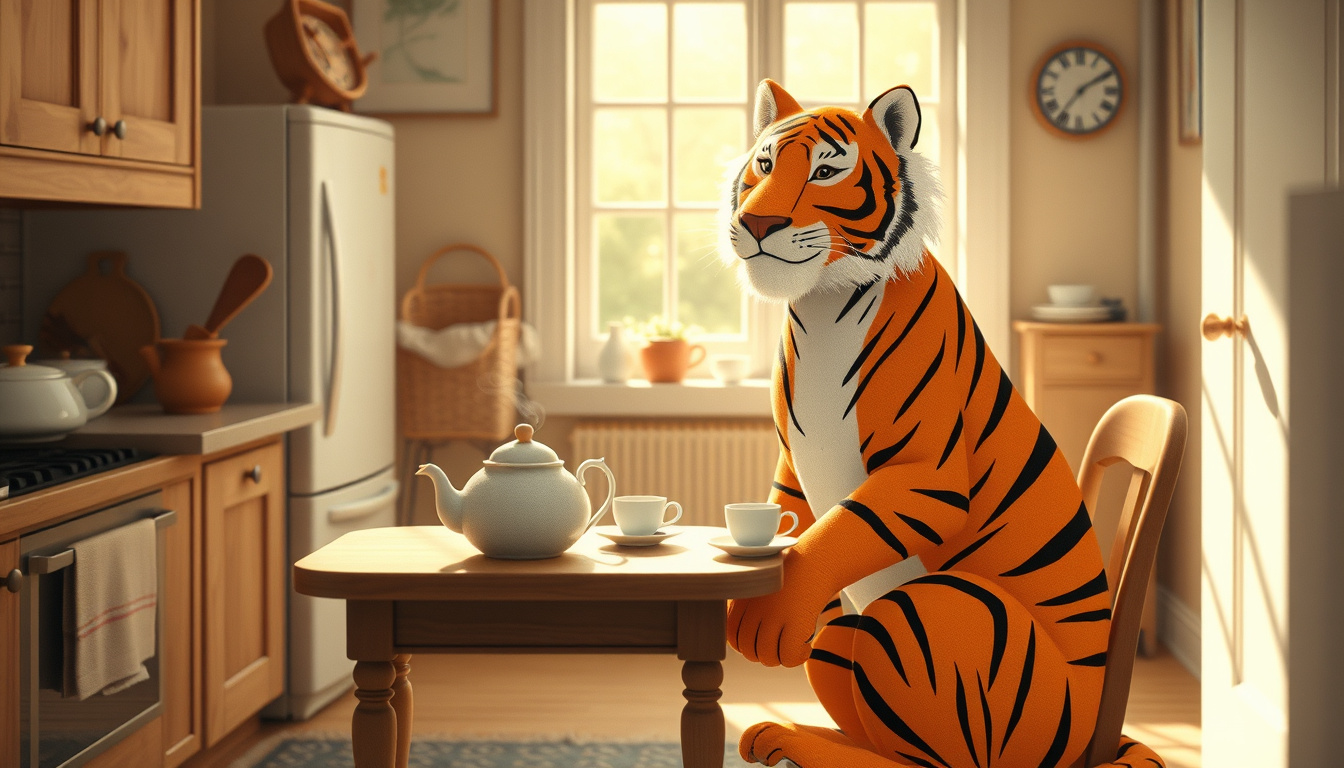
A hungry tiger walks into a house for afternoon tea and eats everything in sight. That simple, absurd premise is the heart of Judith Kerr’s beloved picture book The Tiger Who Came to Tea, first published in 1968. More than five decades later, the story of Sophie, her mother, and their enormous striped guest remains a staple of children’s literature and has been transformed into a stage play and an animated television film.
The book follows Sophie and her mother as they sit down for tea when a tiger appears at the door. He joins them and consumes all the food and drink in the house – then leaves without a word. Sophie’s father comes home, and the family goes out for dinner. That is the entire plot, yet generations of young readers have been captivated by its warmth, repetition, and quiet mystery.
The story’s enduring appeal has led to two major adaptations: a stage show featuring music, dancing, and audience participation, and a 2019 animated movie aired on Channel 4. Each version stays true to the original while adding new layers of charm for contemporary audiences.
Where can I watch The Tiger Who Came to Tea?
- Judith Kerr wrote the story after her daughter Sophie asked what a tiger would do if it came to tea.
- The simple plot and vibrant illustrations have made it a classic bedtime story for over 50 years.
- The tiger is often interpreted as a symbol of childhood imagination or unexpected hospitality.
- The animated adaptation aired on Channel 4 in 2019 with a star cast including David Walliams, David Oyelowo, and Benedict Cumberbatch.
- The stage show is marketed as an ideal first theatre experience for kids because it is interactive and easy to follow.
- In the stage adaptation, the tiger is presented as a “big friendly cat,” not a scary predator.
| Fact | Detail |
|---|---|
| Author & Illustrator | Judith Kerr |
| First Published | 1968 |
| Publisher | William Collins, Sons |
| Main Characters | Sophie, Mummy, the Tiger |
| Number of Pages | 32 (standard edition) |
| Adaptations | Animated film (2019), stage play (2022–present) |
| Sales | Over 9 million copies worldwide |
The animated television movie is available to watch on Channel 4 in the UK. It aired on Christmas Eve 2019 and runs for 29 minutes. The same platform also offers short clips and behind‑the‑scenes content. On YouTube, the official Warwick Arts Centre channel posted an access video for the 2025 stage production, showing how the show is staged and how actors switch costumes. For families who prefer to read the book, it is widely available at retailers such as Amazon UK and in library systems.
What is the meaning and moral lesson of The Tiger Who Came to Tea?
Interpreting the tiger: hunger, curiosity, or imagination?
The tiger has been read in many ways: as a symbol of the unexpected, a representation of a child’s imagination, or simply a funny animal. Judith Kerr herself said she “just thought it would be funny if a tiger came to tea.” There is no single correct interpretation, and that is part of the book’s charm. The tiger is never explained, and he never comes back – he simply disrupts the ordinary and vanishes.
Teachers often ask children: “Why do you think the tiger left without saying goodbye?” or “Would you invite the tiger back?” These open-ended questions encourage young readers to think about hospitality, consequences, and imagination.
The moral lesson: hospitality and generosity
Although the book does not state a moral directly, many parents and educators see it as a story about hospitality and kindness. Sophie and her mother welcome the tiger without hesitation, even though he eats everything they have. The family ends up going out for dinner together, turning a potential disaster into a shared adventure. The lesson is subtle: be generous, and even an odd situation can become a happy memory.
Common classroom discussion points
In early years settings, The Tiger Who Came to Tea is used to explore themes of sharing, the unexpected, and problem‑solving. Children are asked to predict what happens next, sequence the story, and even draw their own version of a surprise visitor. The repetitive language and simple structure make it ideal for developing literacy skills.
Who wrote The Tiger Who Came to Tea and is it based on a true story?
Judith Kerr: author and illustrator background
Judith Kerr (1923‑2019) was a German‑born British writer and illustrator. She fled Nazi Germany with her family in the 1930s and later settled in London. Her most famous works include The Tiger Who Came to Tea, the Mog series, and the autobiographical novel When Hitler Stole Pink Rabbit. Her distinctive illustration style – bold, simple lines and bright colours – has become instantly recognisable.
Publication history and legacy
First published in 1968 by William Collins, Sons, the book has never been out of print. It has sold more than 9 million copies worldwide and remains a fixture on nursery and primary school bookshelves. The 32‑page hardback is still the standard edition.
Fact or fiction: the real inspiration behind the story
No, the story is not based on a true event. Judith Kerr repeatedly stated that the idea came from her daughter Sophie’s lively imagination and a trip to the zoo. The tiger is entirely fictional, and Kerr never hinted at any autobiographical meaning behind the character.
Is there a stage show or movie of The Tiger Who Came to Tea?
The Tiger Who Came to Tea stage show at Theatre Royal Haymarket
A live stage adaptation premiered at the Theatre Royal Haymarket in London in 2022 and continues to run as of 2025. It features music, singing, dancing, magic, and audience participation. The cast – including Devon Black, Alan Atkins, and Abbey Norman in the original production – play multiple roles, with quick costume changes that children find exciting. The tiger is portrayed as a “big friendly cat” and the show is designed to be an ideal first theatre experience for children.
The Theatre Royal Haymarket website provides a visual guide and sensory information for families. The show runs about 55 minutes, making it suitable for very young audiences, and includes full audience interaction.
Animated adaptation cast and crew (Channel 4, 2019)
The 29‑minute animated movie aired on Channel 4 on Christmas Eve 2019. It featured an all‑star voice cast: David Walliams as the tiger, Clara Ross as Sophie, Tamsin Greig as Mummy, and David Oyelowo as Daddy, with additional voices from Benedict Cumberbatch and Paul Whitehouse. The production brought Kerr’s illustrations to life while expanding the story with gentle humour and music.
Future adaptations and availability
As of early 2025, no sequel or new adaptation has been formally announced. The stage show at the Theatre Royal Haymarket is expected to continue through the year, and the book remains a staple in early childhood education. For families wishing to see a live performance, advance booking is recommended due to high demand.
When was The Tiger Who Came to Tea published and what are the key adaptations?
- – First publication of The Tiger Who Came to Tea by William Collins, Sons.
- – Animated adaptation aired on Channel 4 (UK) with David Walliams as the tiger.
- – Stage adaptation premiered at Theatre Royal Haymarket, London.
- – Stage show continues at Theatre Royal Haymarket; book remains in print and available globally.
Is The Tiger Who Came to Tea based on a true story?
Some readers wonder whether a real tiger inspired the book, especially given the vivid detail. The table below clarifies what is known and what remains uncertain.
| Established information | Information that remains unclear |
|---|---|
| The story is entirely fictional. Judith Kerr said the idea came from her daughter Sophie’s imagination and a visit to the zoo. | No specific tiger or event is known to have inspired the character. |
| Judith Kerr never claimed the story was autobiographical or based on a real incident. | Some fans speculate that the tiger might symbolise something more personal, but Kerr never confirmed any hidden meaning. |
How has The Tiger Who Came to Tea remained a classic for generations?
The book’s staying power lies in its perfect balance of warmth and strangeness. It never explains why the tiger comes or where he goes, leaving space for a child’s own imagination. The themes of hospitality, family, and the joy of a shared meal – even after a crisis – resonate with readers of any age. Judith Kerr’s clear, colourful artwork is instantly engaging, and the repetition of the tiger “eating all” the food is both funny and reassuring.
Educators particularly value the story for its simplicity and its openness to interpretation. It can be read as a straightforward tale, a metaphor for the unexpected guest, or an invitation to talk about sharing and kindness. Because it works on so many levels, it has survived the test of time and continues to be a first book for millions of children around the world.
The stage play has further extended its life, introducing the story to new audiences who may not have encountered the book. The interactive elements and live performance add a fresh dimension while staying faithful to Kerr’s original vision.
What do critics and readers say about The Tiger Who Came to Tea?
“I just thought it would be funny if a tiger came to tea.”
– Judith Kerr, from an interview about the book’s origin
“It is a classic in the sense that it has never been out of print and continues to delight toddlers and their parents.”
– The Times, book review
The book has earned praise for its timelessness and its ability to engage very young readers. Parents frequently note that the simple sentence structure and repetitive phrasing make it a favourite for bedtime reading. The stage show has also received positive reviews for its warm, interactive approach, with many outlets calling it “the perfect first theatre experience.”
What is the lasting impact of The Tiger Who Came to Tea?
The Tiger Who Came to Tea remains one of the most beloved children’s picture books in the English language. Its influence extends beyond the page: it has inspired a hit stage show, a star‑studded animated film, and countless classroom discussions. For families looking for more recommendations, our guide to Best children’s books for ages 2‑6 includes many other classic titles. If you are planning a trip to London, the London theatre shows for families 2025 article lists the best family‑friendly performances on now.
Frequently asked questions
What age is The Tiger Who Came to Tea suitable for?
The book is generally recommended for children aged 2 to 6 years. The animated movie and stage show are also family‑friendly for the same age group. The stage show is designed as a first theatre experience for toddlers and preschoolers.
How can I get a Tiger Who Came to Tea costume?
DIY options include orange clothing, face paint, and a tiger tail. Ready‑made costumes are available from online retailers and party shops. The stage production uses distinct costumes for each character, with actors changing jackets for different roles.
Where can I buy The Tiger Who Came to Tea book?
The book is widely available at bookstores, online retailers such as Amazon, and library systems. Most major bookshops carry it in multiple formats, including board book and paperback.
Is there a sequel to The Tiger Who Came to Tea?
No sequel was published. Judith Kerr wrote other children’s books, including the Mog series and When Hitler Stole Pink Rabbit, but the tiger never returned for another tea party.
Is the tiger scary in the stage show?
No. The stage adaptation presents the tiger as a “big friendly cat.” The emphasis is on comedy and audience interaction, not fear. Children call out to the tiger and laugh at his antics.

Henry Wallace is Managing Editor at NewsPrism.co.uk, running the daily news list and covering UK and world affairs.