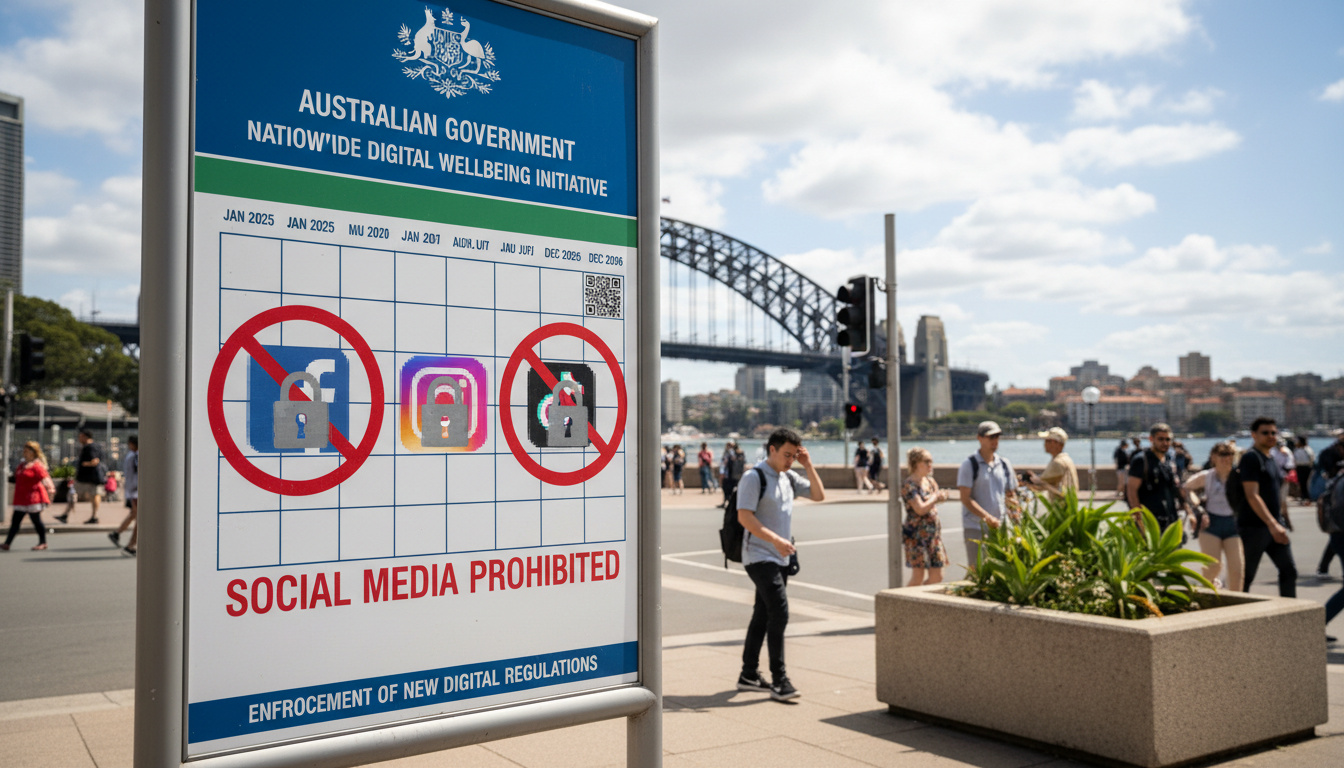
The Online Safety Amendment (Social Media Minimum Age) Act 2024 prohibits Australians under 16 years of age from holding accounts on designated social media platforms, establishing one of the strictest digital age-gating frameworks globally. Royal assent was granted on 29 November 2024, with enforcement commencing 10 December 2025 following a mandated twelve-month transition period.
The legislation imposes liability solely upon technology companies, requiring reasonable measures to prevent underage account creation while explicitly prohibiting penalties against children or parents. Violations carry civil fines reaching A$49.5 million for systemic failures, though the framework bans platforms from demanding government-issued identification for age verification.
What is the Australia social media ban?
- World-first federal approach: The legislation establishes a nationwide standard rather than state-level variations, with bipartisan parliamentary support distinguishing it from regional proposals.
- Strict platform liability: Responsibility rests entirely with social media companies to enforce age restrictions, with no legal obligations imposed upon parents or minors.
- Privacy-centric verification: The Act explicitly prohibits requiring government-issued identification, mandating alternative age-assurance technologies.
- Comprehensive coverage: Designated platforms include Facebook, Instagram, TikTok, YouTube, and X, among others.
- No consent exemptions: Unlike earlier South Australian proposals, the federal ban allows no parental override for 14-15 year olds.
- eSafety oversight: The eSafety Commissioner administers enforcement through civil penalty regimes, gaining specific court powers for fines on 16 September 2025.
| Fact | Details |
|---|---|
| Legislation Name | Online Safety Amendment (Social Media Minimum Age) Act 2024 |
| Royal Assent | 29 November 2024 |
| Effective Date | 10 December 2025 |
| Age Threshold | Under 16 years |
| Maximum Corporate Fine | A$49.5 million |
| Parental Penalties | None |
| Verification Standard | Reasonable steps (behavioral inferencing permitted) |
| ID Requirements | Government ID prohibited |
| Primary Regulator | eSafety Commissioner |
| Notable Exemption | Roblox (as of 5 November 2025) |
| Investigations Begin | Late March 2026 |
Which platforms and age groups are affected?
Designated platforms
The legislation applies to major social media services including Facebook, Instagram, Reddit, Snapchat, TikTok, X (formerly Twitter), Threads, Twitch, Kick, and YouTube. Minister Michelle Anika Wells issued final rules on 30 July 2025 specifying these platforms, despite Google’s legal threats regarding YouTube’s inclusion.
Age threshold specifics
The ban applies strictly to individuals under 16 years of age. Platforms must prevent new account creation by underage users and terminate existing accounts held by this demographic. The prohibition contains no graduated phase-in for teenagers approaching their 16th birthday.
While Roblox received exemption status on 5 November 2025, Reddit and Kick were subsequently added to the designated list, expanding regulatory coverage beyond initially anticipated scope.
When does the ban start and how will it be enforced?
Implementation timeline
Enforcement became effective on 10 December 2025, exactly one year following royal assent. By late March 2026, regulators had launched investigations into Facebook, Instagram, Snapchat, TikTok, and YouTube regarding repeated underage verification attempts and new account creation.
Technical enforcement methods
Platforms must employ “reasonable steps” to identify and block Australian under-16s, including those attempting access via VPN technologies. An August 2025 age verification report confirmed technical feasibility contingent upon industry coordination, permitting biometric analysis and behavioral inferencing while maintaining privacy protections.
Penalty structure
Companies face fines up to A$49.5 million for systemic failures to prevent underage accounts. The eSafety Commissioner may pursue civil penalties through court proceedings, though the legislation imposes no fines upon parents, children, or individual users.
Platforms bear responsibility for detecting and blocking underage users attempting to mask their location or age through VPN services or other technical circumvention methods.
The legislation explicitly forbids platforms from demanding government-issued identification documents, ensuring age verification systems cannot compromise user privacy through centralized ID databases.
Is parental consent allowed under the ban?
No. The legislation contains absolutely no provisions for parental consent or override mechanisms. This federal approach contrasts sharply with early 2024 South Australian proposals that considered allowing parental approval for 14-15 year olds. The blanket prohibition applies uniformly regardless of guardian permission, educational context, or supervised usage scenarios.
How did the legislation progress from proposal to law?
- Early 2024: South Australia proposes state-level ban for under-14s with parental consent for 14-15s.
- September 2024: Prime Minister Albanese announces federal intent; Robert French’s feasibility report endorses technical viability.
- 8 November 2024: Government commits to legislation; Opposition confirms support.
- 27-28 November 2024: House passes bill 102-13; Senate passes 34-19 with privacy amendments prohibiting government ID requirements.
- 29 November 2024: Royal assent granted; twelve-month transition period begins.
- 30 July 2025: Final rules issued specifying platforms including YouTube.
- 31 August 2025: Age verification report confirms technical feasibility.
- 5 November 2025: Roblox exempted; Reddit and Kick added to designated list.
- 10 December 2025: Age restrictions become legally effective.
- Late March 2026: Investigations launched into major platforms for verification failures.
What aspects remain certain versus unclear?
| Established Facts | Uncertain Elements |
|---|---|
| Age limit fixed at under 16 | Long-term efficacy in reducing youth mental health impacts |
| No parental consent permitted | Precise technical standards for “reasonable” verification |
| Corporate fines capped at A$49.5 million | Success rate of VPN detection systems |
| Government ID prohibited | Potential migration of minors to unregulated platforms |
| eSafety Commissioner leads enforcement | Outcome of pending legal challenges from tech giants |
| Roblox exempt; others designated | Impact on regional and LGBTQI youth support networks |
What opposition and reactions have emerged?
Greens Senator David Shoebridge argues the ban isolates vulnerable youth, particularly regional and LGBTQI teenagers who rely on digital communities for mental health support. Child welfare groups have expressed concerns regarding unintended harms, while cross-bench parliamentarians delivered mixed responses during debates.
Technology companies have mounted significant resistance, with Google threatening lawsuit over YouTube’s inclusion and industry representatives warning the rushed legislative process risks privacy erosion for all users. Critics suggest the ban may drive children toward unregulated dark web environments while reducing platforms’ incentives to improve safety features.
What have key figures said about the ban?
“This ban isolates vulnerable youth, particularly those in regional areas and LGBTQI kids who use these platforms to stay connected and access mental health support.” For a deeper dive into the social media ban, visit $aussiebrief.org.
— Senator David Shoebridge, Australian Greens
“The legislation represents a world-first approach to protecting children online, placing the responsibility where it belongs: on the platforms themselves.”
— Prime Minister Anthony Albanese (paraphrased from government statements)
What is the current status of the legislation?
The Online Safety Amendment Act 2024 currently stands as active law with full enforcement underway since December 2025. Platforms face immediate investigatory scrutiny regarding compliance failures, while the eSafety Commissioner exercises newly granted court powers to levy substantial fines. As digital privacy debates continue globally, including coverage by BBC News UK Today, Australia’s framework serves as a critical test case for age-gating legislation worldwide.
Frequently asked questions
Will parents be fined if their child creates a social media account?
No. The legislation imposes penalties solely upon platforms. Parents and children face no fines, criminal charges, or legal liability for account creation attempts.
How will platforms verify age without government ID?
Platforms must use “reasonable steps” including behavioral inferencing, biometrics, and technical analysis. They cannot demand driver’s licenses or passports.
What happens to existing accounts held by under-16s?
Platforms must terminate existing accounts held by users under 16 and prevent these users from creating new accounts once enforcement begins.
Are there exceptions for educational use?
No exemptions exist for educational contexts, parental supervision, or school-related activities. The prohibition applies uniformly to all account holders under 16.
Can children use VPNs to bypass restrictions?
While children might attempt VPN usage, platforms bear legal responsibility for implementing reasonable technical measures to detect and block such circumvention attempts.
Which platforms are exempt from the ban?
As of November 2025, Roblox remains exempt from designation, while Reddit and Kick were specifically included in the final regulatory rules.
How does this relate to reality television controversies?
While both involve media regulation and child protection, the social media ban specifically targets digital platforms rather than broadcast content standards.

Amelia Grant is Technology & Media Editor at NewsPrism.co.uk, covering AI, platforms, cybersecurity, consumer tech and the media landscape.